Cyber threats are increasingly moving from IT networks into OT and ICS environments across the UAE’s oil and gas, utilities, and smart logistics sectors. Learn how organizations can reduce operational risk and strengthen critical infrastructure resilience.

In most enterprise breaches, the first concern is data. In operational technology environments, the stakes are different. A cyber incident does not stop at stolen files or encrypted laptops; it can interrupt production, affect safety systems, disrupt utilities, and in the worst cases, create real-world physical consequences. Industrial control systems and OT networks underpin the UAE’s oil and gas operations, utilities, transportation hubs, and increasingly smart logistics infrastructure, which makes them a strategic target rather than a niche security concern.
That shift matters because threat actors are no longer treating IT and OT as separate worlds. Once an attacker gains a foothold in business systems, the next objective may be lateral movement into engineering networks, remote access pathways, or industrial control environments that were never designed to withstand modern cyber campaigns. SANS reported that 38% of compromises to ICS environments in 2023 originated from compromises in IT networks that then allowed threats to traverse into ICS environments.
Why OT risk is rising
The UAE’s heavy industries and critical infrastructure sectors are digitizing rapidly, but many industrial environments still rely on legacy control systems, specialized protocols, and operational processes built for reliability and uptime rather than cyber resilience. The National reported that vulnerabilities in the energy industry often stem from aging industrial control systems that have not been fully upgraded or integrated, while phishing and social engineering still remain common entry points despite the sophistication associated with critical infrastructure threats.
That combination creates a dangerous imbalance. On one side, operators are connecting more assets, enabling remote support, integrating IT and OT workflows, and modernizing plants for efficiency. On the other, many OT environments still contain flat networks, weak segmentation, unmanaged remote access, outdated firmware, and limited monitoring of industrial protocols. Middle East reporting has repeatedly highlighted that gaps between IT and OT security practices, insecure remote access, and legacy SCADA exposure continue to create exploitable conditions in industrial sectors such as utilities, oil and gas, and transport.

How attackers move from IT into OT
The breach path is often less cinematic than people imagine. Attackers do not always begin with a direct assault on a control system. More often, they start with an email account, a remote desktop session, a contractor credential, an internet-exposed service, or a trusted vendor connection. From there, they map relationships, escalate privileges, and look for routes into engineering workstations, historian servers, HMIs, or other operational systems that bridge business and industrial networks. SANS emphasizes that organizations should examine all access routes from IT networks and the internet into ICS segments, including vendor pathways and remote connections, with MFA enforced across those routes.
This is one of the defining problems in modern industrial cybersecurity: the initial compromise may look like a conventional IT incident until it reaches the plant floor. Once that happens, the security assumptions change. Standard IT containment actions are not always safe in OT environments, because systems must be evaluated in the context of uptime, process integrity, and human safety. SANS explicitly warns that remediation actions designed for traditional IT systems can be ineffective or even dangerous when applied directly to ICS incidents without OT-specific planning and expertise.
The UAE sectors most exposed
The UAE’s OT exposure is not limited to one vertical. Oil and gas remain one of the most visible targets because of its economic importance and regional concentration of industrial assets. A Microsoft-linked white paper cited survey results showing that 50% of cyber-attacks in the Middle East target the oil and gas sector, while 60% of surveyed personnel believed the OT environment faced greater risk than IT, and 67% said the risk to industrial control systems had increased substantially over recent years.
Utilities face similarly high pressure because disruption can affect public trust and essential services at scale. Transport and smart logistics are also becoming more exposed as ports, warehouses, industrial routing systems, and connected infrastructure rely on digital control, automation, and IIoT integration. A 2026 regional threat analysis reported that transport infrastructure accounted for 49% of OT and ICS incidents in the region, with oil and gas refineries accounting for 26%, underscoring how attackers are concentrating on sectors where digital compromise can create outsized operational impact.
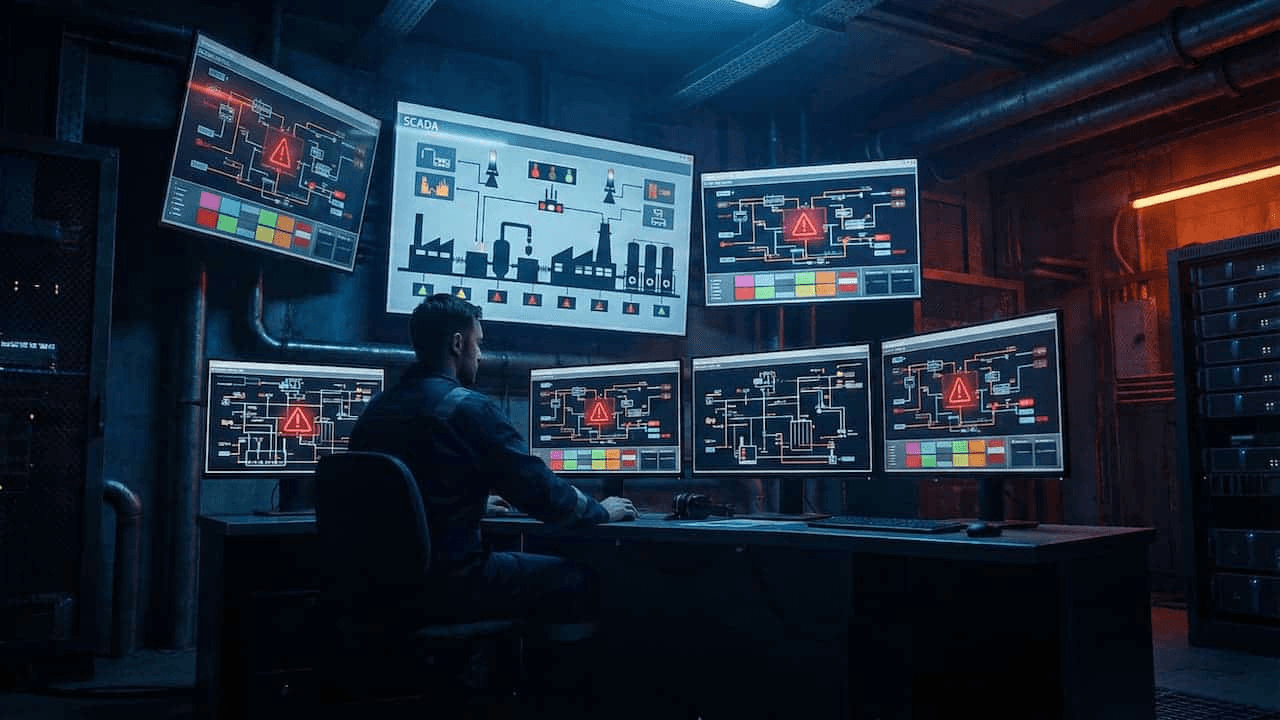
The visibility gap inside industrial environments
Many organizations still believe they are protecting OT because they have perimeter firewalls, endpoint tools in parts of the environment, and a broad cyber policy that covers “all systems.” That confidence is often misplaced. OT security depends on asset visibility, protocol awareness, network architecture, remote access discipline, and engineering-informed incident response. Without those elements, security teams may know they have a problem, but not which controller, segment, or process is actually at risk.
That is why ICS-specific monitoring is becoming essential. Kaspersky ICS CERT reported that from January to September 2022, malicious objects were blocked on 37.9% of industrial computers in the UAE, with attacks arriving from internet-facing exposure and email-borne vectors among the most common sources. Kaspersky also recommended continuous vulnerability assessment, timely updates where technically possible, and stronger detection and response capabilities inside OT networks.
The lesson is simple: what organizations cannot see in their OT environment, they cannot defend with confidence. And unlike IT environments, uncertainty in OT carries a safety and continuity cost, not just an investigative one.
What resilient OT security looks like
A mature OT security strategy in the UAE should start with the recognition that safety comes first and that cybersecurity exists to support safe, reliable operations. Dubai’s cybersecurity guidance has specifically recognized the need for ICS-focused standards to secure critical national infrastructure, reflecting how important OT security has become to the broader resilience agenda.
From there, organizations should focus on a practical set of priorities:
Map industrial assets, communications paths, and trust relationships across plants, substations, depots, and connected operational sites.
Enforce strict segmentation between IT and OT, with special scrutiny on any bridge systems, remote support paths, and engineering access routes. SANS identifies defensible control system architecture, ICS network visibility, secure remote access, and risk-based vulnerability management among the five critical controls for ICS cybersecurity.
Treat vendor and contractor access as a high-risk pathway, especially where remote maintenance, field support, or third-party engineering access is involved.
Build OT-specific incident response plans that are coordinated with engineering, safety, operations, and executive leadership rather than relying only on enterprise IT playbooks.
Use monitoring tools that understand industrial protocols and process context, because generic IT telemetry alone does not provide sufficient insight into abnormal behavior inside ICS environments.
The strategic shift ahead
The most important change for security leaders is conceptual. OT is not simply another subnet to defend. It is the layer where cyber risk can become operational disruption, environmental damage, safety compromise, or critical service failure.
For the UAE’s oil and gas producers, utilities operators, industrial facilities, and smart logistics ecosystems, that means the conversation has to move beyond generic cyber maturity. The real question is whether the organization can prevent business network compromise from becoming process-level compromise, and whether it can detect abnormal movement before attackers reach the systems that control the physical world. In the Gulf region, ICS threats continue to evolve toward disruption, destruction, and safety impact, with examples such as PIPEDREAM and TRISIS frequently cited as evidence that adversaries are increasingly willing to target operational processes directly.
Critical infrastructure security is no longer about drawing a hard line between IT and OT and hoping that line holds. It is about understanding every path across that line and defending it with the seriousness that physical consequences demand.
Contact us at info@defa3.com for a free security assessment with the Defa3 team today.
FAQ
Why is OT security different from traditional IT security?
OT security is different because it protects systems that control physical processes, industrial operations, and safety-critical environments rather than standard business data and user devices. In ICS environments, response decisions must account for uptime, engineering constraints, and human safety, and SANS notes that IT-style remediation can be ineffective or dangerous if applied without OT-specific planning.
How do attackers typically get from IT networks into OT environments?
Which UAE sectors are most exposed to OT and ICS threats?
What should organizations do first to improve OT security?